Rules of the Road

I hope you will find my blog interesting and inspiring. To help make your visit more profitable, please observe these Rules of the Road.

1. I am not a rabbi. If you have a question regarding halachah (Jewish law) please consult a rabbi.

2. Please do not visit on Shabbat or Jewish holidays.

3. Feel free to comment on any post. Please be respectful when commenting. All comments will be reviewed.

4. Additional resources are listed at the end of each post for readers who would like more information on the topic.

5. Please explore the other pages of this blog to learn about the basics of living a Jewish life and to find out more about me and my projects.

6. You may contact me via email at welshabba@gmail.com or leave a text or voice message at 267-225-8573.

Showing posts with label Raising Jewish Children. Show all posts

Tuesday, August 17, 2021

Home at Last! Finding a Synagogue Community

There's a joke around our house that goes: Elul is pizza month. Why pizza month? Because we receive so many invitations to pizza parties for prospective new synagogue members! During the month of Hebrew Elul synagogues are looking to increase their memberships before the High Holy Days. If you live in an area with several synagogues nearby, your name might find its way onto their list.
 
If you are currently looking for a synagogue home, you probably ask yourself one familiar question, "How do I find the right one?" Here are a few suggestions for those of you who are unsure how to proceed.
 

Ask yourself some questions

Where should the synagogue be? Do I want to walk to shul or am I comfortable with a short drive to services?
 
Orthodox? Reform? Conservative? Something else? Different communities have different styles of worship and different requirement for membership.

Do I want a smaller, more intimate community or a large synagogue with a greater variety of services?

How comfortable am I with Hebrew? Do I want a traditional service with mostly Hebrew, or a more contemporary style with less Hebrew?

How much can I afford? In addition to dues, many synagogues require additional fees for building maintenance, religious school, etc. You may need financial assistance if the fee structure gets expensive. Am I comfortable asking for help?

Do your homework

Check out Jewish resources to learn about synagogues on your area. Besides good old "Rabbi Google" (the internet) the local Jewish Federation often has information about Jewish communities in their service area. In larger metro areas there might be a local Board of Rabbis to offer assistance.

Learn as much as you can about specific synagogue communities. Do they have a Rabbi? Or two? A Cantor? What kind of Religious School programs do they offer? If you have young children you will want to know what programming they offer for them. Do you have special needs to consider? Accessibility? LGBTQ? Physical or developmental disability? Do they offer special interest programming beyond worship and education? Men's Club/Sisterhood? Older adults? teens?

Pay them a visit

Arrange to attend a service at a shul that interests you. After you get home think about your experience there. Did I feel welcomed? How comfortable was I participating in the service? What impression did the Rabbi/Cantor make? Do I feel like I could fit in there? If you have more questions don't be afraid to speak to the rabbi. He/she will be happy to assist.

Choosing a synagogue can be a daunting task. Take your time! Get to know as much as you can about the community that you find interesting. Make sure it is a good fit. You will find the experience fulfilling when you find the right synagogue community.

Related links:


Thursday, November 19, 2015

Responding to Terrorism

As I write this entry the world is still coming to grips with the horrible terrorist attacks in Paris, France. More than 100 people were brutally murder at locales in and around the great city. In Israel terrorists continue to assault Jews in stores, on streets even in places of prayer. One is tempted to ask, "Is there anywhere that is safe to go? Is anyone - Jew or gentile, religious or not, liberal or conservative - free from the danger of being attacked or killed, G-d forbid." In years gone by, one could tell who the enemy was and where he was likely to be encountered. Nowadays the most innocent looking child standing on a street corner might be wearing a vest-bomb and willingly sacrifice his or her life in the name of "god." How can a Jew live in such a world?


Don't do it alone

In times of fear and uncertainty, banding together as a community is essential. While numbers alone are not a guarantee of safety (ask the survivors of the Parisian soccer game) coming together to support one another, to daven together, to share life together builds the inner strength one needs to go about the daily tasks with a feeling of confidence. Let us not forget that Hashem is with us. Nothing can come against us without G-d's knowledge. Of course we should plan, make appropriate security arrangements, be aware of our surroundings and report suspicious activity to civil authorities. But ultimately it is G-d who rules and watches over His people.


Do not allow fear to keep you from living your life.

If we lock ourselves in our homes and give up doing our daily tasks, the terrorist gain another victory. Will cowering make us safer? Will hiding our Jewish identity bring security? The answer is obvious: Certainly not! I actually heard someone suggest that we have a moral obligation to remove our kipot when we leave the synagogue! What foolishness! Imagine the rejoicing in the terrorists' camp when they see us abandoning our faith, hiding our identity. On the contrary, we should reaffirm our Jewish pride. Wear that kipah everywhere! Continue to perform mitzvot even if doing so makes you "look" Jewish. Go to the supermarket and buy kosher. The very best way to fight back is to keep doing what the Torah tells us to do.


Do an extra mitzvah.

Our rabbis tell us that each mitzvah bring the light of holiness into the world. In this time of darkness the world needs this light all the more. Ladies, light extra candles this Shabbos. Gentlemen, put on tefilin. If you have never laid tefilin before contact your local rabbi to learn how. Give extra tzedakah. Express your love for your fellow Jew. Attend services at your local shul. Have you mezzuzot check to ensure they are kosher. "A tiny light expels much darkness!"


But one might object, isn't all this a bit naïve? What of the impact on my family? Am I not putting them at risk by being so open in a hostile world? As David Ha'melech has written, "Even when I walk through the valley of the shadow of death, I fear no evil. For You (Hashem) are with me!" We must continue to live our lives with confidence and trust in G-d. Whatever may come His Will will be done. Our trust is in Hashem. Our confidence comes from performing His mitzvot. Again to quote from Tehillim, "From whence comes my help? My help comes from the L-rd, Maker of heaven and earth!"


Related links:
How to Talk to your Kids about Paris Attacks
How Jews Respond to Terror (Video)

Wednesday, June 10, 2015

How to Have a Jewish Vacation

Now that warmer weather is here (at least in the Northern Hemisphere) many of us are thinking about vacation time. It is important to find time to take a break from the routine of life, relax and refresh our bodies and souls. How does an observant Jew ensure that his vacation doesn't make observance difficult and vacationing stressful? There are many considerations when planning a Jewish vacation. Here are a few suggestions.

1. Look for a kosher hotel.

If you are planning to stay in a hotel, ask if they have a "Shabbos elevator" (one that does not require you to operate it directly) or accommodations on a lower floor so that you can move about on Shabbat without difficulty. Does the hotel use electronic keys? These cannot be used on Shabbat. There may be restrictions that prevent the lighting of candles on Shabbat. If so check with your rabbi to find out how to deal with that issue. If you are planning a camping trip, be sure to review the campground's rules and regulations to insure that there will be no conflict with Shabbat observance.

2. Search for kosher food.

Even in this internet age this task might not be as easy as you think! Does the hotel have a kosher restaurant? If not is there one nearby? Is there a kosher grocery store in the area? What about Shabbat meals? Is there a community nearby where one might spend Shabbat? Is there a Jewish traveler's aid society who could arrange for your Shabbat needs? If you are camping, carefully plan how you will store your food. Are you a tent camper? Make sure no insects can invade your food storage.

3. Find a synagogue.

Check with your denomination (Orthodox Union, United Synagogue, URJ, etc.) to find a synagogue near where you plan to stay. You can also check the Internet for suggestions. If you are going to a place where there are few Jewish accommodations, you consult with your local Chabad-Lubavitch center or other outreach program to learn what special arrangements might be made.

4. "Shabbat-in-a-Bag"

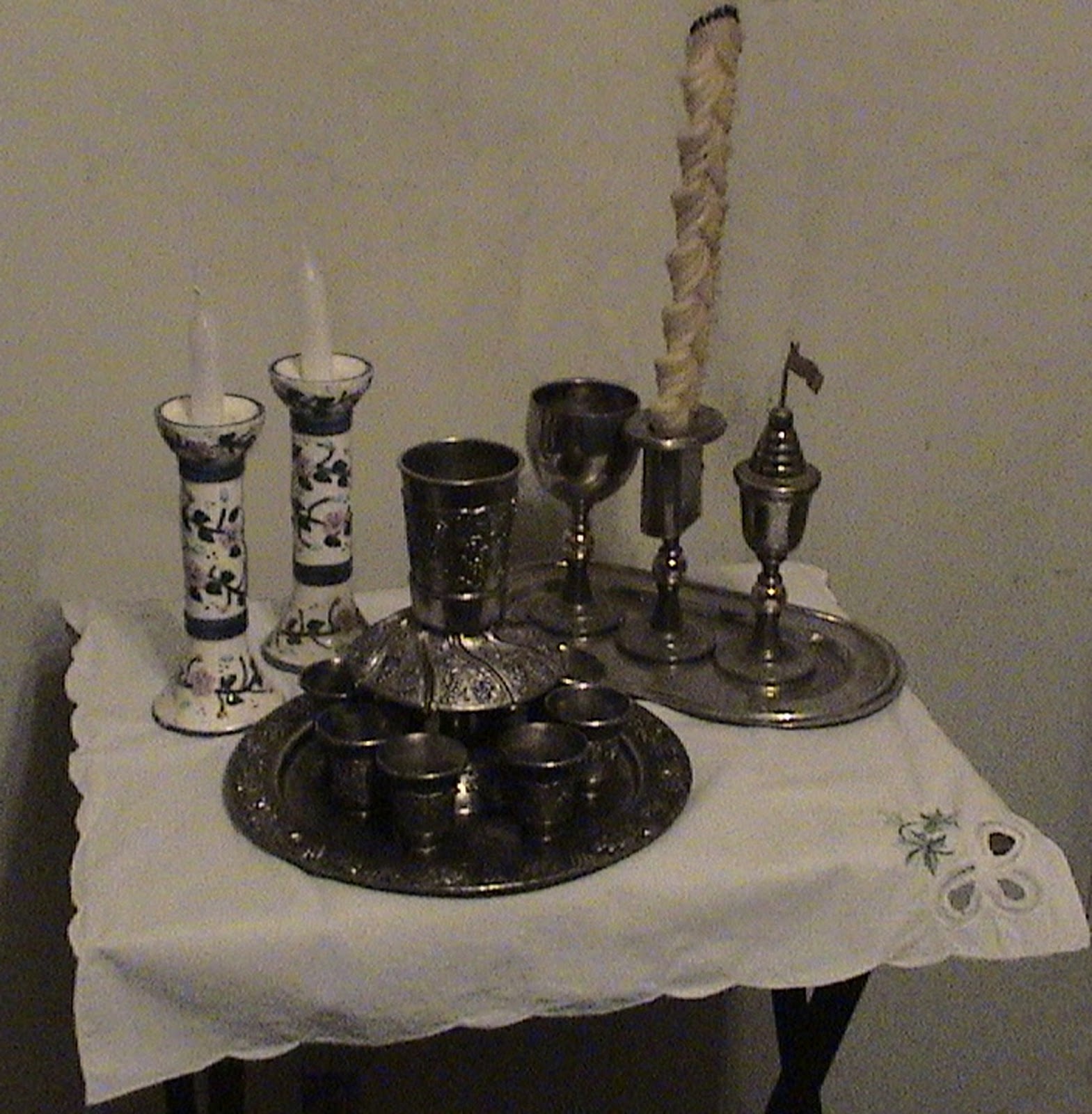
Several years ago my wife and I came up with what we thought was a unique way to have our Shabbos ritual items packed and ready to go when we went on the road. We called it "Shabbos-in-a-Bag." We quickly discovered that our idea was not so unique! However here is how we set up our Shabbat-in-a-Bag so that we would have everything we needed to take Shabbos with us on vacation.
  1. We found a lovely set of silver-plated four cups with a matching metal tray that is just large enough to hold two challah rolls. We purchased the set and a beautiful silk napkin. Ready for Kiddush!
  2. Well almost. We take a small bottle of wine or grape juice with us. Now we're ready for Kiddush. (By the way, if you are crossing state/provincial lines or traveling to another country, you probably will not be able to take wine with you. Under those circumstances grape juice will suffice.)
  3. There are small candle sticks that can be added to the bag. Be sure to include candles and matches of course. If you don't have the proper size candle sticks, check your local Judaica store. If you are staying where candles are not permitted, check with your rabbi before leaving on your trip.
  4. For Havdallah, we save the last three or four inches of a Havdallah candle and put it in the bag. Spices wrapped in a piece of cheesecloth and tied with a ribbon serve as besamim
  5. Place all these items in an attractive canvas bag and you have Shabbat-in-a-bag!
Certainly there are many other considerations. You will want to be sure to pack a talit, a siddur, and other necessities, etc. Hopefully I have given you a place to start as you plan for your trip. Remember: a Jewish vacation is not a vacation from Judaism! Have a safe and restful time. May your going be in peace and your return be in peace..

Related links: 

Sunday, March 1, 2015

Purim: Let's Have Some Fun!

Purim is a celebration of the miraculous salvation of the Jewish people that is recorded in the book of Esther (Megilat Ester). It is a time of great rejoicing and festivity that is celebrated on the 14th day of Adar. This year (Ed.: 2015) the date coincides with March 4 and 5. How is Purim celebrated? What mitzvot and traditions do we observe that make Purim such an unusual event?

1. We hear the Megilah.

The Megilah or the Book of Esther is read. It is an important mitzvah to hear the story of our deliverance from destruction at the hands of the Persians. Most synagogues will have a special Megilah reading and often community organizations sponsor special events that will include reading the Book of Esther. When the name of Haman, the arch enemy, is chanted it is customary to shake groggers (noisemakers) or boo in an effort to drown out his name. 

2. We give to the needy.

One should give money or food to at least two poor persons on Purim. If you cannot give it directly to the person, at least donate to your synagogue benevolence fund or a Jewish charity. This is not he time to be checking and verifying the person's circumstances. Give generously!

3. We send mishloach manot to friends.

Mishloach manot are small baskets of food (cookies or other treats, fruit, beverages) that are given to Jewish friends on Purim day. Tradition is to have children or another third party deliver the basket on your behalf.

4. We feast!

Have a festive meal that includes great food, good wine and other beverages, singing, laughter and merriment. Tradition teaches that one should enjoy his celebration to the extent that he cannot tell the difference between "cursed be Haman" and "blessed be Mordechai"! Of course if you decide to follow this tradition you should be sober until after the megillah is read and plan to walk home!!

5. We dress in costume.

Children and even some adults dress in costumes portraying the heroes of the Esther story, especially Mordechai and Esther. This is NOT a Jewish Hallowe'en!! Make sure the costumes are positive, cheerful characters!

6. Other prayers are added to the regular service.

Al hanissim (For the miracles) is added to the Amidah. There is a special Torah reading during the morning service. Exodus 17: 8-16 tells of Joshua's battle with Amelek, Haman's evil ancestor.

If you do not know where to go to hear the Megillah in your area, contact your local rabbi. Have a joyous, fun-filled Purim!

Related links:

Wednesday, July 10, 2013

Making Shabbat Special

A few years ago I was having a conversation with some friends about how we could make Shabbat special for our families, especially our children. One father's remark has stayed with me since then. "My children always know when it's Friday night," he said with a wry smile. "Shabbat is the only day when we have dessert!" I doubt that you will find his suggestion in any book of Jewish ritual, but he certainly has the right idea. In order to appreciate how special Shabbat is, the day has to be different somehow. Of course there are distinctive mitzvot (candle lighting, kiddush, etc.) and they are important by themselves. But how these mitzvot are done can be as important as simply doing them. This month I have decided to share a few suggestions that could help make Shabbat more meaningful and unique for your family.

Involve the Whole Family

There is an old saying, "You remember only 10% of what you see, but 90% of what you do." When family members participate in "making Shabbat" they are likely to both "remember" and "observe" as the Torah commands us. In my family for example, my wife and both of our daughters chant the candle blessing. My son has assumed the duty of preparing the Shabbat meal, giving Mother a well-deserved rest! When everyone has a role to play the family bonds around the Shabbat.

Our Shabbat Best


Give Shabbat Your Best

Set the table with your best dishes. Spread a white tablecloth (a symbol of purity). Have a special cup that you use only for making kiddush. Perhaps decorate the table with some flowers. Make the setting festive! If a very important guest was coming to your home, wouldn't you want to extend special hospitality? What "visitor" could be more important than the Shabbat Queen?

Do Something Different

Be creative in your observance. Learn some Shabbat songs and spend some time with the family singing and dancing on Shabbat. In good weather have a Shabbat meal outdoors, especially if you have access to a beautiful setting like a garden. Tell or read stories to your children. If your children are older, involve them in studying the weekly Torah portion. If they are grown and living on their own, invite them to spend Shabbat with you. Take a family Shabbat walk. And of course there is my son's favorite activity: the traditional Shabbat nap! 

The very nature of Shabbat is a day set apart from the usual, workday activities. It is a day to connect with G-d, with Torah and with each other. Shabbat observance doesn't have to be complicated or difficult, but it must be special. With a bit of forethought, Shabbat can the most wonderful, enjoyable day of each week. To you and your family, I wish Shabbat Shalom!

Relate Links:
Notes on Shabbat Observance (Ritualwell)
Shabbat (Judaism 101)
Shabbat.com

Friday, May 17, 2013

"Teach Them to Your Children"

One of the most challenging responsibilities for any Jewish parent is transmitting the Tradition to his or her children. The task often seems even more daunting when one is still new to Jewish observance himself. So many questions crowd into the mind: How can I teach what I don't fully understand myself? What if my children really don't want to learn Torah? How can I make Jewish values and rituals relevant to my children? These questions and more make some parents reluctant to start. Too many parents simply delegate the task of teaching Judaism to the local synagogue. Far too often, when Bar/Bat Mitzvah class ends so does the child's Jewish observance!

I remember how intimidated I  felt when I first began my Jewish journey. Fortunately I quickly discovered that sharing Torah with my children was not "mission impossible!" In this post I will share some tips that I have learned "Along the Way." I hope they will inspire you to begin or to carry on!

You have already started!

As I have reminded parents on many occasions, we are all teachers. Your children see what you do and hear what you say. They interact with you in countless ways.Your children learn quickly what you consider important in your life. When you light Shabbat candles, observe Chanukah, attend synagogue services, or perform mitzvot, you are teaching your children that these are things that matter. That in itself is a very important lesson.

Children want to learn.

They may not admit it, but your children want to learn. They are looking for meaning and purpose in life. Even when they seem to be rebelling, it is because they are frustrated at not understanding or not having found an answer. Don't give up! Be positive, be enthusiastic, and most importantly be consistent. If you are there for them eventually they will come to you.

Brit Milah

Start sharing now.

A parent once asked me, "When should I start my child's Jewish education?"

"How old is your child?" I asked.

"Seven years old."

I smiled and said, "You are about seven years too late!"

Seriously, my wife and I took our children with us everywhere we went even as infants. They learned not only that there is a Jewish way to light candles and to pray, but there is a Jewish way to attend a baseball game and go shopping. When children grow up with Jewish values and Jewish observance, they are learning to be Jewish.

Learn with your children.

Don't be concerned that you "don't know it all." No one does! As you study, learn and practice, share what you learn with your children. Learning and growing together will build a lasting bond between you and your children that is built on Jewish values and mitzvot. My son is now 34 years of age and we still learn and study together.

Synagogue school and Jewish day school are both valuable resources, but there is no substitute for the parent-child relationship for lasting learning. To build a strong relationship and insure the transmission of the Tradition to the next generation, the task of teaching our children diligently falls to us parents. Give it your best effort. "If you raise a window the tiniest bit, Hashem will fling open the door!"

Related links:
Learning Resources (URJ)
My Jewish Learning (website)
Jewish Living and Learning (USCJ)

Sunday, January 6, 2013

Name That Jew

On the Shabbat that has  just passed, Parshat Shemot was read and studied.  Shemot mean "names" and the opening section of the parshah gives a list of names of Jacob's sons.  Appropriately enough, the subject of the meaning and significance of one's Jewish name was a topic of discussion.  Is there really something special about a Jewish name?  Isn't a name really just a means of identification?  Perhaps the name might be given to honor the memory of a loved one, but could there possibly be a greater significance than that?

A Jewish name binds its bearer to his people.

The Midrash teaches that the Hebrews were freed from Egyptian slavery in part because they kept their Jewish names.  They did not identify with or assimilate with the majority culture.  They remained a distinct people while still living within the Egyptian civilization.  The lesson for today is obvious.  It is sad that so many of my Jewish friends do not want to be "different."  They think of themselves as simply "Americans."  There are certainly many wonderful things about being a citizen of the United States.  I am an native of the USA myself and enjoy the freedoms and privileges that citizenship in the United States affords me.  However one need not sacrifice his Jewishness in order to be a good citizen!  I and a great many of my fellow Jews celebrate of Tradition proudly without being disloyal or disrespectful to the country of our birth.  My Jewish name is as much a part of my identity as the names given to me by my parents.

A Jewish name binds its bearer to Hashem.

Tradition teaches that it is through one's name that the Divine energy flows to the soul.  The name is more than a label.  It is a link!  When one is called to the Torah, he is called by his Jewish name.  When approaching the Sacred Torah a person is receiving a lesson from the Divine.  As we pray we communicate with G-d in both a communal and individual sense.  Whether symbolically, metaphorically or literally, these acts bring a genuine spiritual energy into our lives as Jews.  How tragic it would be to lose that vital link by disowning one's Jewish name!

A Jewish name binds its bearer to Tradition.

Within the many varied expressions of Jewish life, there are many traditions surrounding the naming of a child.  Some communities name him or her after a relative or a respected teacher or a significant person in Jewish history.  Other names are bestowed because of their meaning.  Some rabbis will allow a Jew-by-Choice to select his/her own name; others bestow a name upon them.  During my conversion process I chose to be called Avi (meaning my father) out of respect for my birth parents.  The name Avraham was bestowed upon me as a reference to Avraham avinu. My wife and I chose very special Jewish names for our three children: David (beloved) Datya (faith in G-d) and Rina (joy).  Each name has become an expression of the spirit and soul of each of them!

Whatever your Jewish name might be - whether Yiddish or Hebrew - carry it with pride!  Speak it often and with respect.  Through it you will know the power, joy and reality of being Jewish.  What is your name?  Shemi Avi!  (My name is Avi!)

Related Links:

Thursday, December 6, 2012

Enjoy the Lights!

As winter begins to arrive, we celebrate the Festival of Lights!  Hanukkah rituals are simple, beautiful and meaningful. This season is a wonderful time for families to bond around the celebration of Jewish history, values and traditions.   Unfortunately for many Jewish families, Hanukkah is overshadowed by that "other" December holiday.  How can a Jewish family make Hanukkah special when all around us our Christian neighbors fill the world with their celebration?


Hanukkah at a shopping mall

Don't Compete with Christmas

Christmas is Christendom's biggest holiday.  Hanukkah is a relatively minor Jewish holiday. They are simply very different. Trying to recreate Hanukkah would only create more envy among impressionable young children.  Let your children admire your neighbors lights.  Explain to them that this is a special day for their friends, but it is not our holiday. I have actually compared Christmas to Chinese New Year: a fun, happy holiday that belongs to a different culture. Believe it or not, it works!

Make Hanukkah Celebrations Fun!!

Use brightly colored candles in your menorah.  Have your children make Hanukkah crafts and decorations and display them around the house.  Have the children help making latkes (traditional potato pancakes) or other Hanukkah treats.  Play dreidle (a fun game using a special Hanukkah top).  Sing Hanukkah songs.  If your local shopping center hosts a candle lighting celebration, take the family to enjoy the festivities.  Just as important: have a good time yourself!  

"Dreidle,dreidle, dreidle"


"Don't let the Light go out!"


 Light the Hanukkah lights


Make Hanukkah Jewish!!

That may sound silly but it isn't at all.  Learn the candle blessing in Hebrew, if you do not already know it. Use Jewish symbols when you decorate. Men and boys should wear kippot during the celebration.  Attend synagogue services and chant Hallel.  The Macabees fought for our right to live as Jews in a world that tried to destroy us and our way of life.  Hanukkah presents an ideal opportunity to share with our children this priceless heritage.

For you and all those you love, I wish the blessings of freedom, the joy of Hanukkah and the light of Hashem's presence.  Hanukkah sameach!

Related links:

Wednesday, October 10, 2012

Happy Holidays!

We have come through the busiest season of the Jewish year in terms of  the number of holidays we observe in such a short period of time.  I hope and trust that you and those you love found the season enriching and uplifting.

After the solemn self-examination of the Days of Awe, we take to the out of doors to celebrate Sukkot and bring the holidays to a triumphant conclusion on Simchat Torah.

Today I have decided to share with you a few pictures of my family's celebrations.  Of course the pictures were taken after the holidays, but they convey some of the joy and enthusiasm we felt.

My favorite shofar. It has a wonderful tone.

The Aston family dancing in front of our sukkah.

Sukkah under construction!

I have shared thoughts on many topics these few months.  Some have been solemn, others thoughtful.  More than anything else I hope you remember that Judaism is alive!  As you study, learn and practice Judaism, remember to take time to just enjoy being Jewish.

Monday, September 3, 2012

Creating a Jewish Home (Part 2)

In my last post I tried to describe what a Jewish home was like. It is a wonderful, beautiful place, but in practical terms how can a home become a Jewish home?

Begin with the family.

Judaism places a great value on relationships, particularly family relationships. Begin by teaching and demonstrating love and respect for each other within the family. Make Jewish celebrations family events. Gather the children around while Mother lights the Shabbat candles. Encourage everyone to participate in the Passover seder. Attend synagogue services as a family. The more that the family bonds around Jewish events, the stronger the Jewish spirit of the home.

Give your home a Jewish look.

Begin by attaching a mezzuzah to the doorposts of you house. Contact your rabbi to learn how to perform this mitzvah properly. He may even be able to suggest a suitable ceremony to accompany the affixing of the mezzuzah. Invite family and friends to witness to event. Make it a significant occasion!

Mezzuzah
Set aside items for ritual use. Kiddush cups should only be used for kiddush. Have a separate set of candlesticks for Shabbat and Yom Tov. Try to obtain Judaica that is festive and attractive. It need not be expensive, but it should be special. Look for Jewish art to decorate your home. 

We found this picture at a synagogue sale.


"Go forth and Learn."

"Let your house be a meeting place for scholars...drink in their words thirstily." (Ethics of the Fathers 1:4) Learning is a vital part of being Jewish. Aside from providing required knowledge, study and learning have added benefits. It increases one's discipline and self-confidence. They strengthen the sense of morality, deepen an individual's spirituality and bond him to G-d, his loved ones and his fellow Jews. Take advantage of learning opportunities. Synagogues and other Jewish educational institutions often offer courses available to the public. Enroll your children in a Jewish educational program, either at your local synagogue or at a Jewish day school. Add good Jewish books to your library and set an example by reading regularly. And always remember the three primary rules of learning: 1. Practice. 2. Practice again. 3. Practice more! Use what you have learned.

See the World through Jewish eyes.

As you strengthen your own Jewish soul, you will gain an awareness of opportunities to grow and to practice Jewish values and mitzvot. When your family gathers for Shabbat you will find opportunities to learn and discuss Torah. A simple charity box placed in a convenient spot in your home makes giving tzedakah simple. Resources for living a Jewish life are everywhere, if you only look with "Jewish eyes." Over the years I have found Judaica everywhere. I have found Jewish books being sold by a local library that was clearing its selves of older books,  a seder plate at a thrift store, Jewish art at a synagogue rummage sale, Hanukkah decorations at a neighborhood craft shop. Finally seeing the world through Jewish eyes also means realizing in practical ways that we are partners with G-d in perfecting the world. It is a big task that can only be accomplished if everyone does the little things that are within his capabilities. Our sages remind us that we are not responsible to complete the task, but neither are we exempt from doing it!

A rabbi once told me that the Tradition teaches that "if we open a window the tiniest crack, Hashem will throw open the door." Once you begin to put the Jewish life into practice you will find, as I have, that G-d will be with you to reward your efforts. It is a lifetime commitment, but "let us begin!"

This article is posted in honor of my beloved wife, Ariella bat Ariyeh ha Cohen, in celebration of  the twenty-first anniversary of the creation of our Jewish home.

Related links:
More about mezzuzot (Chabad)
"Lessons of the Mezuzah" (United Synagogue)
Jewish Learning (Trans-denominational)
Orthodox Union

Monday, August 20, 2012

Creating a Jewish Home (Part 1)

What is a Jewish home? Is it just a buidling with a mezuzah on the doorpost? Is it a family comprised of at least one Jewish parent all living together in one place? Or is there something about it that make a Jewish home distinctively different ? What makes a home a Jewish home?

A Jewish home has a Jewish spirit.

When you enter a Jewish home, you immediately feel the joy of life that enlivens the family. Everyone enjoys the delights of Yiddishkeit. Shabbos is a celebration, filled food and wine, Torah and mitzvos. Z'miros fill the air. Father chants the kiddush and mother chants the blessing over the candles. Children proudly display their decorative crations in the sukkah in the fall. Their faces beam brightly as they chant the four questions at seder in the spring.

A Jewish home is graced with love and respect.

Husband and wife value and love each other and share in the privelege of the mitzvah of creating their Jewish home. Children are are taught to live Torah values and perform mitzvos. Elder family members are treated with respect and their wisdom is cherished. Hospitality abounds! Guests are welcomed warmly on Shabbos and Yom Tov and are invited to share in the happiness that gives the home a special glow.

A Jewish home is proudly Jewish!

On the bookshelves, Jewish books are displayed as prominently as the great lierary classics. Jewish art adorns the walls. Recordings of great Jewish music sacred and secular can be heard throughout the house. A mezuzah marks each doorway. Kiddish cups, menorahs, and other ritual objects add to the festivity of special days throughout the year.

A Jewish home is alive.

Its Jewish spirit is vibrant and growing. It is not like a museum where one might wonder what life was like when these artifacts were used. No! It is a place enlivened by a family who loves each other and their fellow Jews. It is a place where Torah comes alive in word and deed. It is a place where the world is elevated to a higher plane of holiness, one mitzvah at a time.

When my family began to build our Jewish home, it seemed such a daunting task. So many things to learn and do! I thought I would have to find someway to make this transformation in an instant. Fortunately my wife and I discovered the excitement and sheer joy that comes from growing as an observant Jew.

If you feel as we did, dear friend, do not be discouraged. We began simply. First we began by making Shabbos special. We studied and learned and then we began to practice what we had learned in our home. A rabbi once told me that the Tradition teaches that "if you open a window even the tiniest crack, Hashem will fling wide the door!" So begin; even if what you do seems "small," begin. There are no "small" mitzvos. Once you have begun, you will see your Jewish home grow and grow.

May you be blessed with success in all your worthy endeavors. And may you go from strength to strength.

This article is posted in honor of my beloved wife, Ariella bat Ariyeh ha Cohen, in celebration of  the twenty-first anniversary of the creation of our Jewish home.

Related articles:
A Woman's Perspective

Wednesday, March 14, 2012

Dayenu: A Passover Lesson

Without a doubt, Passover is my favorite holiday. Pesach requires a great deal of preparation and I suppose that is one reason why so many of my Jewish friends don't like this holiday. But I love preparing for the Seder, sharing the message of freedom with friends and family, and watching the excitement glowing in my children's eyes. The festive meal, the energetic singing, and the sheer joy of the day make Passover the highlight of the year for me.

Almost fifteen years ago I faced a great challenge in preparing for Seder that year. My youngest was only a toddler. She was born with Down's Syndrome, a chromosomal disorder. Among other challenges that she faces is the reality that she is mentally retarded. I wanted very badly to make sure that she was able to learn and enjoy all the richness of Judaism for herself. How was I to "diligently teach" a child whose ability to learn might be severely restricted? She had not even spoken her first word yet! We had involved her in every Jewish observance since the day she came home from the hospital as an infant, but I had no idea if she had retained anything from these experiences.

As I often do when confronted with a dilemma I cannot solve, I consulted a trusted rabbi. His response was illuminating.
"The Torah doesn't tell us to make our children into little rabbis. It simply commands us to teach them diligently. If you teach, she will learn!"
With renewed confidence I prepared to teach on Seder night. My little student sat silently at the end of the table. Was she following anything I was saying? I could not tell. Then we arrived at that magical moment when we recite the wonders that Hashem has done for us, and declare Dayenu, "it is enough for us."

To the great amazement of us all, my daughter joined in singing, "Day..dayenu, dayenu dayenu!" She sang her first word...a Hebrew word...Dayenu! 
If she had only clapped her hands, it would have been enough! If she had sung some unintelligible babble, Dayenu! But she sang "Dayenu" in perfect Hebrew

Today my daughter chants the candle lighting blessings on Shabbos and Yom Tov. She literally runs to kiss the Torah scroll in synagogue. She sings heartily the Hebrew songs that she has learned. And she lives a truly Jewish life. How much more we bless Hashem for all the multiple blessing she has given us! Dayenu!

As you prepare for Passover, my family joins me in wishing for you and those you love the Passover Joy that we have. Dayenu!

Related Links:
Pesach - Torah Tots
Games and Tips for the Seder
Passover for Kids - Tzivos Hashem Kids